Waikato Hospital Laboratory will stop offering myoglobin (blood and urine) from 17 August 2026 onwards. Consequently, myoglobin screening will no longer be offered by Pathlab.
This decision is associated with the implementation of a new Laboratory Information System (LIS) at Waikato Hospital Laboratory. During the project, the software vendor advised that the calculation required for urine myoglobin reporting is too complex to implement within the available timeframe. Therefore, a review of myoglobin test utilisation was undertaken, covering the first six months of 2026.
Urine Myoglobin:
- 47 requests were received during the review period.
- 2 samples were positive for myoglobin. The corresponding creatine kinase (CK) concentrations were 124,758 U/L and 32,900 U/L, respectively.
- Review of a random sample of 10 negative results showed:
- CK within the normal range in 5 cases.
- No CK result available in 1 case.
- Elevated CK concentrations of 17,600 U/L, 5,680 U/L, 13,000 U/L, and 25,000 U/L in 4 cases.
Blood Myoglobin:
- 16 requests were received during the review period.
- Only 1 request was associated with a patient who had a markedly elevated CK concentration (124,758 U/L).
- The remaining blood myoglobin requests were considered to have been requested for inappropriate clinical indications.
Conclusion:
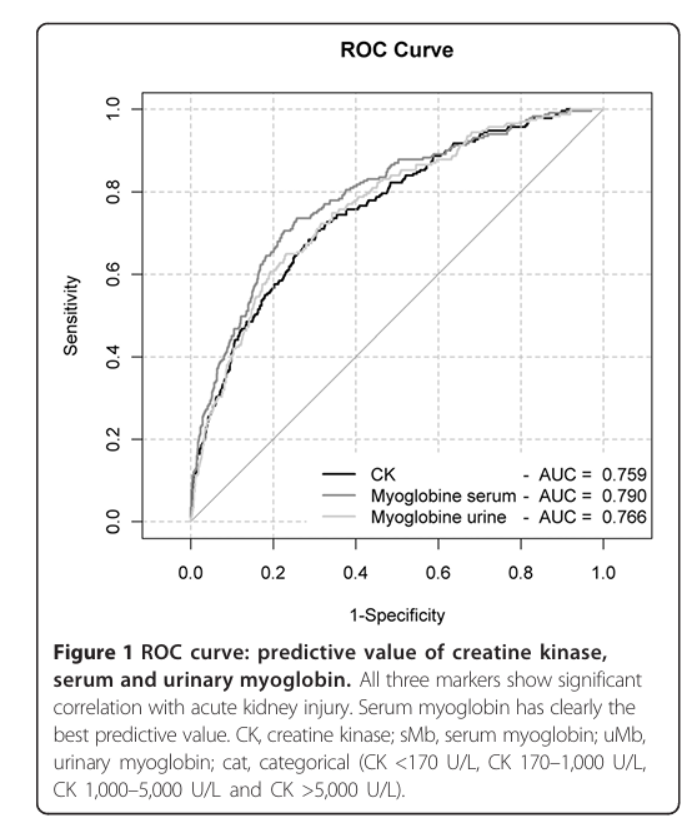
Although myoglobin plays an important role in the pathophysiology of rhabdomyolysis and the development of acute kidney injury (AKI), the review suggests that measurement of myoglobin provides limited additional clinical value when CK is already available. Published evidence indicates that the predictive performance of CK, serum myoglobin, and urine myoglobin is similar for assessing the risk of AKI in patients with rhabdomyolysis (Figure 1, Reference 1).
(1) An observational study on rhabdomyolysis in the intensive care unit. Exploring its risk factors and main complication: acute kidney injury. Annals of Intensive Care 2013, 3:8. http://www.annalsofintensivecare.com/content/3/1/8