Change to PSA Age-Adjusted Referral Thresholds.
From Monday 7th September 2026, Pathlab will adopt the age-adjusted PSA referral thresholds as outlined in the September 2025 Prostate Cancer OCCP.
Due to reporting restrictions, the referral thresholds will be reflected as the reference interval reported alongside the PSA level. These limits should not be interpreted as population reference intervals or diagnostic cut-offs for prostate cancer. Clinical judgement remains essential.
PSA results will be flagged in reporting systems according to the new age-adjusted referral limits noted below. Comments will accompany PSA results to aid in interpretation.
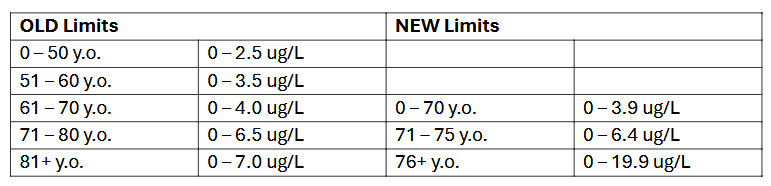
The OCCP recommends referral thresholds of 4.0 μg/L (≤ 70 years), 6.5 μg/L (71 – 75 years), and 20 μg/L (≥ 76 years). These thresholds are intended to guide specialist referral decisions and reflect current national guidance. The changes are summarised as follows.
Accompanying comments:
-
Age ≤ 70 y.o. Clinician-directed PSA thresholds should be used for men with known prostate cancer or a history of previous treatment for prostate cancer. Specialist Urology referral is recommended when the PSA is persistently ≥4.0 ug/L, as per the Optimal Cancer Care Pathway for People with Prostate Cancer (December 2024).
-
Age 71 – 75 y.o. Clinician-directed PSA thresholds should be used for men with known prostate cancer or a history of previous treatment for prostate cancer. Specialist Urology referral is recommended when the PSA is persistently ≥6.5 ug/L, as per the Optimal Cancer Care Pathway for People with Prostate Cancer (December 2024).
-
Age ≥ 76 y.o. Clinician-directed PSA thresholds should be used for men with known prostate cancer or a history of previous treatment for prostate cancer. Specialist Urology referral is recommended when the PSA is persistently ≥20 ug/L, as per the Optimal Cancer Care Pathway for People with Prostate Cancer (December 2024).
Other Important Considerations
A single elevated PSA should generally be repeated after approximately 6 weeks before referral decisions are made, unless clinical concern warrants earlier specialist review.
Referral should also be considered for men with a suspicious DRE regardless of PSA level. Patients with PSA > 50 μg/L and new renal impairment, or imaging suggestive of advanced disease, should be referred via the High Suspicion of Cancer pathway.
PSA should be interpreted cautiously in the setting of suspected UTI or prostatitis. Repeat testing after resolution of infection is recommended.
Summary
From 7th September 2026, PSA reporting will align with the Te Aho o Te Kahu Optimal Cancer Care Pathway for Prostate Cancer age-adjusted referral thresholds.
- ≤ 70 years: refer if PSA persistently ≥ 4.0 μg/L
- 71 – 75 years: refer if PSA persistently ≥ 6.5 μg/L
- ≥ 76 years: refer if PSA persistently ≥ 20 μg/L
These values represent referral thresholds rather than true laboratory reference intervals and are intended to support primary care referral decisions. Clinical judgement, symptoms, DRE findings, and patient context remain essential.