Pathlab is introducing two changes to HPV testing, along with two important collection reminders:
-
Extended genotype reporting — since mid-October 2026, specimens reported as “Other Genotype DETECTED” now include the specific genotype or genotype group detected.
-
New collection kit swab — the HPV dry swab now comes in a peel pack in place of the plastic tube holder. The swab itself and the collection process are unchanged. Distribution starts in November 2026.
-
Reminders — do not collect an HPV swab alongside a SurePath LBC specimen; and always break the swab shaft at the pink break point.
1. Extended reporting of “Other Genotype DETECTED” results
From mid-October 2026, Pathlab reports the additional genotyping information for specimens where a high-risk HPV genotype other than 16 or 18 is detected.
What the assay detects
Pathlab uses the BD Onclarity HPV assay, which detects 14 high-risk genotypes: 16, 18, 31, 33, 35, 39, 45, 51, 52, 56, 58, 59, 66 and 68. Some are identified individually; the rest are detected in one of three pools, where the specific genotype within the pool cannot be determined.
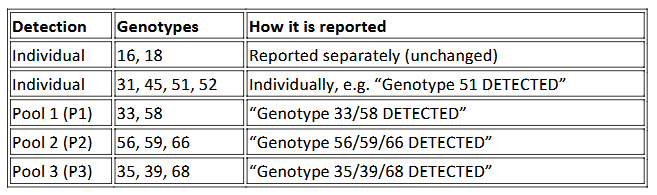
What has changed
- Previously: genotypes 16 and 18 were reported separately, and all other genotypes were reported only as “Other Genotype”.
- Now: “Other Genotype DETECTED” is still reported, as required by National Cervical Screening Programme (NCSP) reporting standards. The additional genotyping result is reported beneath it.
Interpreting pooled results
A pooled result means at least one genotype in that pool is present, but the assay cannot say which. For example, “Genotype 56/59/66 DETECTED” means the patient has genotype 56 and/or 59 and/or 66 — one, two or all three may be present.
Example report
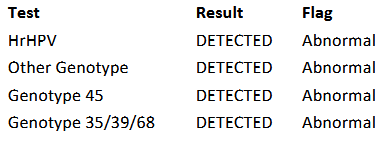
In this example, genotype 45 is present, along with at least one of genotypes 35, 39 or 68.
Interpretation support
Pathlab is preparing additional guidance to help interpret the newly reported genotyping results. This will be published on the Pathlab website when available.
2. New swab packaging in HPV dry swab collection kit
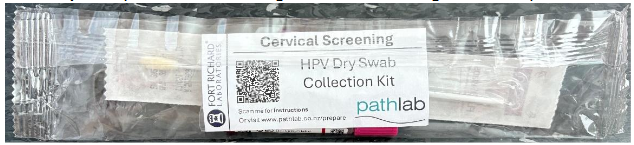
The HPV swab will be supplied in a peel pack, replacing the current plastic tube swab holder. The change significantly reduces plastic waste.
- Swab: identical swab head and shaft design to the current swab, with the same pink break point on the shaft.
- Collection process: unchanged.
- Availability: new packs will be distributed from Pathlab Stores from November 2026.
- Action required: please use all existing stock before moving to the new packs.
3. Reminders
Do not collect an HPV swab with a SurePath LBC specimen
If you are collecting a SurePath liquid-based cytology (LBC) specimen, please do not also collect an HPV swab. If HPV testing is required, it will be performed on the SurePath vial. Collecting both specimen types at the same time is never required. Both samples are likely to be processed and reported, leading to duplicate reports and potential confusion over results.
Break the swab at the pink break point
When breaking the swab shaft off into the dry tube, it must be broken at the pink break point (see picture below). Cutting or breaking the shaft above this point causes the following:
- The swab catches in the tube lid.
- On the automated analyser, the swab is pulled out of the tube with the lid and dropped.
- An empty tube is analysed and a false negative result is reported. The dropped swab may also contaminate the analyser.
- The error is not detected until the following day at the earliest.
- The analyser must be decontaminated, and the patient report amended with a request for recollection.
This causes avoidable distress for you and your patient, from an incorrect result and the need for a repeat sample.

For questions about this update, please contact Pathlab.